EVERY LINE OF THEIR VALUATION
19 checks. Every line of your insurer's valuation.
Insurers price your car from a handful of "comparable" cars and a stack of adjustments. That's where valuations go wrong, so that's what we check, item by item.
- 11 CHECKS
Every comparable car the insurer used
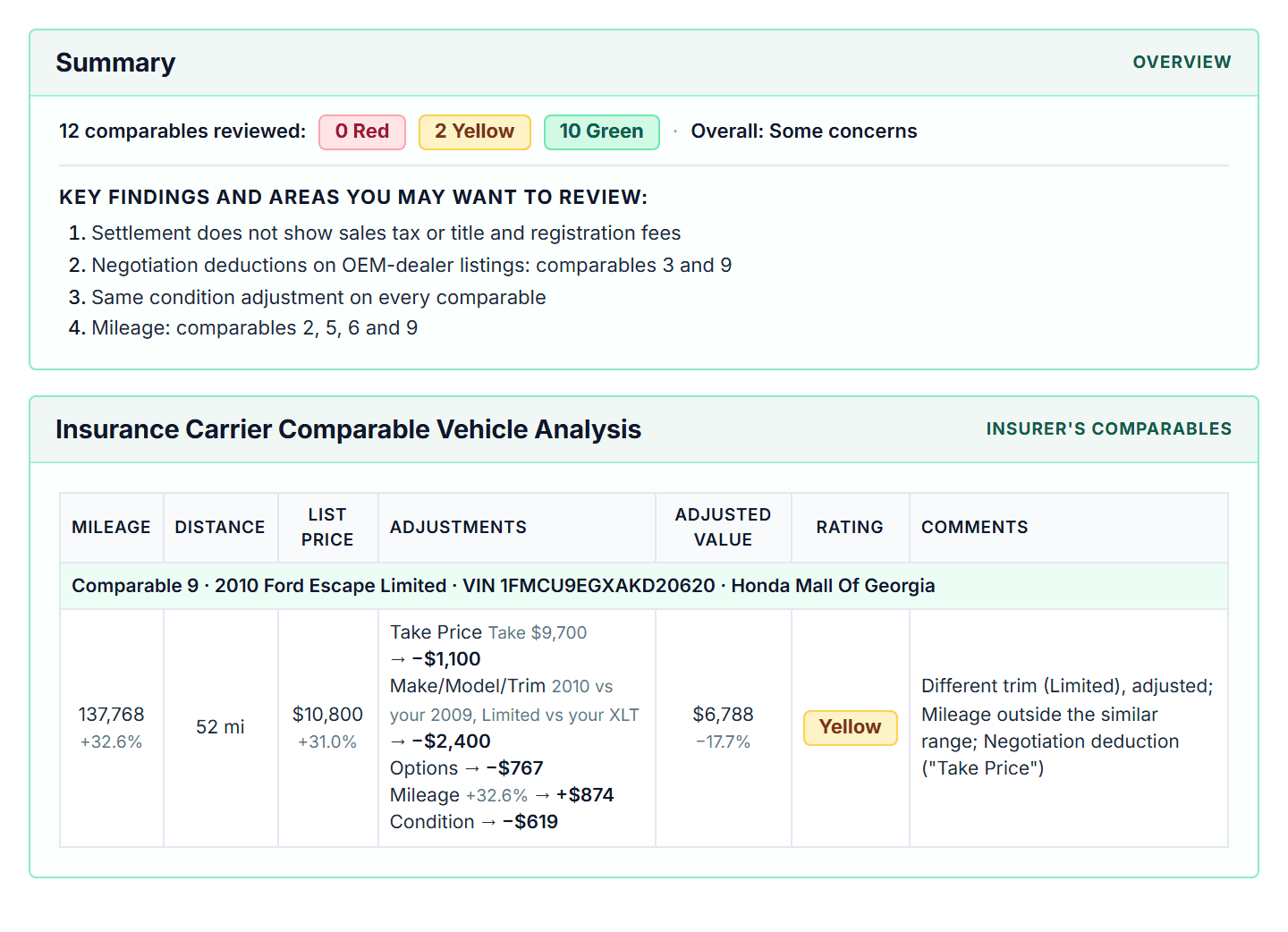
11 checks run on each comparable, one by one.
- Same year, make, model, trim, drivetrain and body as your car, or a fair adjustment for the difference
- A real retail listing, not an auction or wholesale price
- Not your own car listed back as a comparable
- Not the same listing counted twice
- A valid VIN, so the comparable can be traced to a real vehicle
- Mileage close to yours, with large differences flagged
- The mileage adjustment goes the right way (a comparable with more miles than yours should be adjusted up, not down)
- Distance from you, measured against your state's limit
- Negotiation ("haggle") deductions such as "Projected Sold Adjustment", "Typical Negotiation Adjustment" or "Take Price", and whether the seller is a franchise dealer
- Every adjustment itemized, with no unexplained lump sums
- The comparable's adjusted price recalculated from its own figures
- 2 CHECKS
The insurer's math
We recalculate the valuation from the insurer’s own numbers.
- The base value: the average of the comparables, recalculated
- Every step from base value to settlement: condition, prior damage, taxes, fees and deductible
- 3 CHECKS
Your car
Is the car they valued really your car?
- The VIN matches your Total Loss Toolkit report
- Trim, drivetrain, body and engine match your VIN
- The mileage matches what you told us
- 3 CHECKS
The report as a whole
Patterns you only see across the whole valuation.
- The same negotiation percentage applied across the board
- Whether sales tax, title and registration fees are included
- Whether the valuation rests on enough comparable cars, against your state's rule where it sets one
Checked against your state law
Every state writes its own total-loss rules, and insurers don't always follow them. We researched the rules in all 50 states and Washington, D.C., each with its legal citation. Your report quotes your state's rule, links to the source, and points you to your state's insurance regulator. Where your state is silent, we say so.
- 48states have a rule or court ruling on sales tax, title and registration fees
- 33states set rules on how far away a comparable car can be
- 32states set rules for condition deductions
- 28states researched for how many comparables a valuation needs
- 7states restrict or regulate negotiation and dealer-prep deductions
What you get back
- A Red, Yellow or Green rating for every comparable, with the reasons
- Your state's total-loss rules quoted, with the legal citation and a link to your regulator
- The insurer's math, recalculated line by line
- Better-matching listings from your Total Loss Toolkit report, where we find them
- The questions to ask your insurer, and what to ask them to change
Send us your report
Free, no obligation. It takes about two minutes.
- 1Upload your insurer's valuation report. It takes about two minutes.
- 2We run 19 checks against your state's rules and your Total Loss Toolkit report.
- 3You get a written report by email within 72 hours, whether we find something or not.